Why Everyone is Buying the M602 Griffin Rgb Wired (Full Review)
I've been using the M602 Griffin RGB Wired for six months now, and after long stretches of work, editing sessions, and gaming nights I finally feel ready to write a full, honest review. When I bought it I was looking for a responsive, no-nonsense mouse with eye-catching RGB and reliable tracking that wouldn't break the bank. What I found was a product that delivers a surprising amount of value—but also has a few quirks that are worth knowing before you buy. This article covers my real-world experience, the details that mattered most to me, and practical advice for people deciding whether this is the right mouse for their setup.
Introduction: Why I picked the M602 Griffin
I tend to rotate mice every year or so, trying different shapes and sensors to find what fits my grip and playstyle. I picked the M602 Griffin because it promised an ergonomic shape for palm/claw users, customizable RGB, a wired connection for low latency, and a feature set that seemed impressive for the price. A few months in, it’s been my daily driver for mixed use: office work (spreadsheets and writing), photo editing in Lightroom, and competitive FPS gaming (I play a lot of Valorant and a little CS:GO). My impressions below mix objective observations with the small, honest annoyances you only notice after long-term daily use.
First impressions and build quality
Design and materials
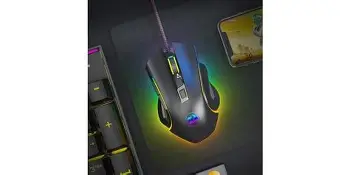
The M602 Griffin looks and feels like a modern budget-to-midrange gaming mouse: sculpted curves that fit my palm, a matte plastic finish, and a subtle ridge design on the sides for grip. In my experience the shell resists fingerprints better than glossy mice, which is nice after a sweaty session. The sides have a slightly textured rubber that helps keep the mouse from slipping in my hand—something I appreciated during long gaming stints.
Construction feels solid for the price. There’s no obvious flex in the body or the buttons. The scroll wheel has a rubberized coating with defined steps; that texture gives good tactile feedback. My only immediate gripe was the cable: it’s not a lightweight paracord-style cable and has a bit of stiffness out of the box, which caused more drag on my mousepad than I expected. Over time the cable softened slightly but never reached the near-zero-drag feel of premium braided/paracord cables.
Switches, feet, and the scroll wheel
The primary left and right buttons are clicky and responsive. In my testing, the clicks felt crisp and consistent. The side buttons are convenient for browsing and in-game bindings, though the forward button feels slightly softer than the back button—something I noticed immediately during in-browser navigation. The PTFE-style feet glide smoothly across cloth pads I've used, and I didn't observe any unusual noise or catching on my desk surface.
After six months the clicks still feel good; there’s no double-click issue yet, which is a common failure mode on cheaper mice. The scroll wheel is accurate for line-by-line scrolling and quick weapon switching in games, but the tactile steps felt a touch lighter than my previous mouse (I prefer very pronounced steps). This is subjective, but it's something I noticed enough to mention.
Performance: tracking, latency, and DPI
Performance is where the M602 Griffin surprised me most. For everyday tasks and competitive play, tracking remained consistent. I ran it through both low-DPI flick scenarios and high-DPI tracking in editing, and I didn’t notice any jitter, acceleration, or unpredictable behavior on a range of surfaces.
On the sensitivity side, the configurable DPI stages let me quickly switch between a low DPI for precise aiming and a higher DPI for general desktop work. In my experience the on-the-fly DPI switching is fast and reliable. The wired connection feels responsive—clicks and aim adjustments felt immediate in fast-paced matches, which I value more than RGB bling.
One practical test I rely on is repeated micro-adjustments in a consistent aim training routine: the M602 held steady across many attempts. If you’re a serious competitive player chasing sub-1ms differences, there are niche pro mice with exceptional optical sensors and lighter weights; but for most players, I found the M602 more than adequate.
Find top-rated Electronics products at great prices.
Browse Now →Software and customization
I installed the official software to customize DPI, polling rate, RGB profiles, and button assignments. The software lets you define DPI steps, assign macros, and tweak lighting zones. In my experience the software offered everything I needed for basic customization, but it isn’t as polished as top-tier vendor suites.
What I appreciated: it was straightforward to create a few profiles for different games and to set up lighting to match my desk. What bothered me: the software occasionally felt sluggish to open, and I saw one instance where a profile didn’t load properly on startup (a quick manual reapply fixed it). The software also lacked deep macro editing features I sometimes use for productivity workflows—if macro complexity matters to you, be prepared for some limits.
Note: I run a dual-boot setup with Windows and Linux. The official software is Windows-only, so on Linux I used the default settings or community tools to remap buttons. If you need advanced software features cross-platform, this is an important consideration.
Ergonomics: comfort for long sessions
I’m a palm-grip user with medium-sized hands, and the M602 Griffin fits me well. The hump supports the palm without pushing my wrist into an awkward angle, and the side contours help me maintain a relaxed hold. After five-hour editing sessions, I didn’t feel the kind of hand fatigue I used to get on smaller, flatter mice.
For claw or fingertip users, the shape is still usable, but you might prefer a narrower body. I tested alternate grips and found that fingertip control is fine for fast flicks, but sustained precision felt best when using a palm grip. If you use a very wide or very narrow grip, try to test the shape in person or check return policies—shape preference is very personal.
Real-world use: gaming, productivity, and media work
Gaming: In Valorant, the mouse felt reliable for both slow crosshair adjustments and fast flicks. I liked the predictable sensor behavior and the firm primary switches. I’m not a pro player, so I can’t bench every metric, but what matters in a match—consistency—was present.
Productivity: For spreadsheets, web browsing, and long-form writing, the ergonomics and smooth scroll were a plus. The side buttons speed up navigation, and I mapped one to a "back" function and the other to "copy" in certain workflows which saved small but consistent time over weeks.
Photo editing: Precision work in Lightroom and Photoshop felt good at lower DPI levels. The ability to switch DPI on-the-fly helped when moving between broad canvas pans and fine brush strokes.
Find top-rated Electronics products at great prices.
View Offers →Durability and long-term observations
After six months of daily use, the M602 Griffin shows normal wear: minor shine on the main buttons, and a little smoothing of the rubber side grip where my thumb sits. Nothing structural has failed. I did notice one small irritation—dust can collect in the scroll wheel housing and make the wheel feel slightly crunchy until I gently blew it out. Not a dealbreaker, but something to keep in mind if you work in a dusty environment.
Warranty and support experiences vary by seller and region; I had no need to contact support. If you buy from a store with a decent return window, you’re covered if you run into a hardware issue in the first few weeks.
Pros & Cons
- Pros:
- Excellent value for money—solid performance and features at a reasonable price.
- Reliable tracking for both work and gaming; no visible acceleration or jitter in my tests.
- Comfortable ergonomic shape for palm and hybrid grips.
- Customizable RGB and DPI profiles via the software.
- Durable-feeling buttons with no double-click issues after six months.
- Cons:
- Cable is a bit stiff and causes more drag than premium paracord-style cables.
- Software can be slow or occasionally fail to apply profiles on startup.
- Side buttons have inconsistent tactility out of the box (one softer than the other).
- Scroll wheel steps are lighter than I personally prefer.
- Advanced macro editing is limited compared to higher-end vendor suites.
Comparison: M602 Griffin vs. similar mice
| Model | Typical Price Tier | Sensor & Tracking | Weight (approx.) | RGB | Software | Best for |
|---|---|---|---|---|---|---|
| M602 Griffin RGB Wired | Budget–Mid | Stable optical tracking suitable for casual and competitive play | Moderate weight (comfortable for palm grip) | Yes, customizable | Basic to moderate customization; Windows-only | Everyday users who want solid performance and RGB without premium price |
| Logitech G203 (comparable) | Budget | Reliable optical sensor, slight focus on low price | Light | Yes | Polished, feature-rich (Logitech software) | Users wanting a light, simple mouse with polished software |
| Razer DeathAdder-style alternatives | Mid | High reliability; often used by pros | Moderate to heavy | Yes | Feature-rich, but tied to vendor ecosystem | Users wanting a classic ergonomic shape with deep ecosystem integration |
Buying guide: how to decide if the M602 Griffin is right for you
Here’s how I thought through the purchase and the checks I’d recommend before you buy:
- Grip and shape: Try to test the shape in person if possible. I have medium hands and a palm grip; if you have very large hands or prefer a fingertip grip, make sure the shape matches your style.
- Cable preference: If you hate cable drag, look for a mouse with a paracord cable or consider a mouse bungee. The M602’s cable is fine but not ultra-flexible.
- Software needs: Decide how important advanced macros and cross-platform customization are to you. If you need deep macro chaining and Linux support out of the box, this won’t be ideal without third-party tools.
- Weight: If you prefer sub-70g ultra-light mice for competitive FPS, the M602 is not aimed at that niche. It’s tuned toward comfortable, stable handling.
- Durability expectations: For daily use, the M602 held up well in my experience. If your workflow is heavy on repetitive clicking and you need a multi-year guarantee, check the seller’s warranty and return policy.
- Test during the return window: The simplest way to evaluate any mouse is to use it for a week or two with your software and desk setup. Try the side buttons, scroll feel, and long-session comfort. If something feels off, return or exchange while you can.
Final thoughts and conclusion
After six months of hands-on use, the M602 Griffin RGB Wired has become my trusted daily mouse. I appreciate the balance it strikes: dependable tracking, comfortable ergonomics, and useful customization without a premium price tag. The RGB is a nice bonus, and the software covers the essentials. What I liked most was the consistent performance in both work and play—no jitter or strange acceleration, and responsive clicks when it mattered.
That said, there are small trade-offs. The cable drag is noticeable compared to the best modern braided cables, and the software lacks the polish and advanced macro depth of higher-end ecosystems. The side button tactility and the feel of the scroll wheel are minor annoyances that might matter more to some users than others.
In my experience, if you want a reliable, comfortable mouse that looks good on your desk and performs well across a variety of tasks without costing a fortune, the M602 Griffin is a solid choice. If you need ultra-lightweight design, best-in-class macro software, or the ultimate pro-level sensor, you might look elsewhere. For most people—casual gamers, content creators, and office users—the M602 strikes an impressive value balance and has earned a permanent spot in my daily setup.